Freaky Friday: Where Did Ultrasound Come From Anyway?
Happy Freaky Friday from Seaside Imaging of Florida! 🌊
We use ultrasound every day to peek inside the womb, watch tiny hearts beating, see little fingers and toes, and capture those precious first glimpses of baby. But have you ever wondered how ultrasound actually got started?
Believe it or not, the technology behind your baby's ultrasound has roots going back more than 100 years!
It All Started With Sound
In the late 1800s, scientists began discovering ways to use sound waves to detect objects and understand what was happening where the human eye couldn't see.
Then came SONAR. During the early 20th century, sound waves were developed to detect objects underwater. Scientists eventually realized “whoooaaaa, if this works to see under water, MAYBE we can use it to look inside an actual human!”
Pretty amazing, right?!
From Sound Waves to Medical Imaging
By the 1940s and 1950s, researchers were experimenting with ultrasound for medical purposes. One of the biggest breakthroughs came from Scottish physician Dr. Ian Donald, whose work in the 1950s helped pioneer the use of ultrasound in obstetrics.
Suddenly, doctors had something that previous generations could only dream about: a way to see a baby before birth.
Those early ultrasound images looked nothing like the detailed images we're accustomed to today. They were basic, grainy and sometimes difficult to interpret—but they completely changed prenatal medicine. Now we could see if a baby was head down and ready for birth or breech….and not so ready. Little did they know back then, this breakthrough in imaging would save so.many babies and their mommas!
And Look How Far We've Come!
Ultrasound eventually progressed from basic 2D black-and-white imaging (still used in most diagnostic imaging) to technology that allows us to watch babies move in real time and create incredibly detailed 3D and 4D images.
Today, ultrasound plays an important role throughout pregnancy—from diagnostic medical imaging to those unforgettable bonding moments when families get to watch their little one wiggle, yawn, stretch or show off those adorable cheeks.
And to think...
It all started with sound waves that we can’t even hear!
Wait…It Gets Freakier!
Patients Had to Get in WATER?!
Here’s where ultrasound history gets a little freaky!
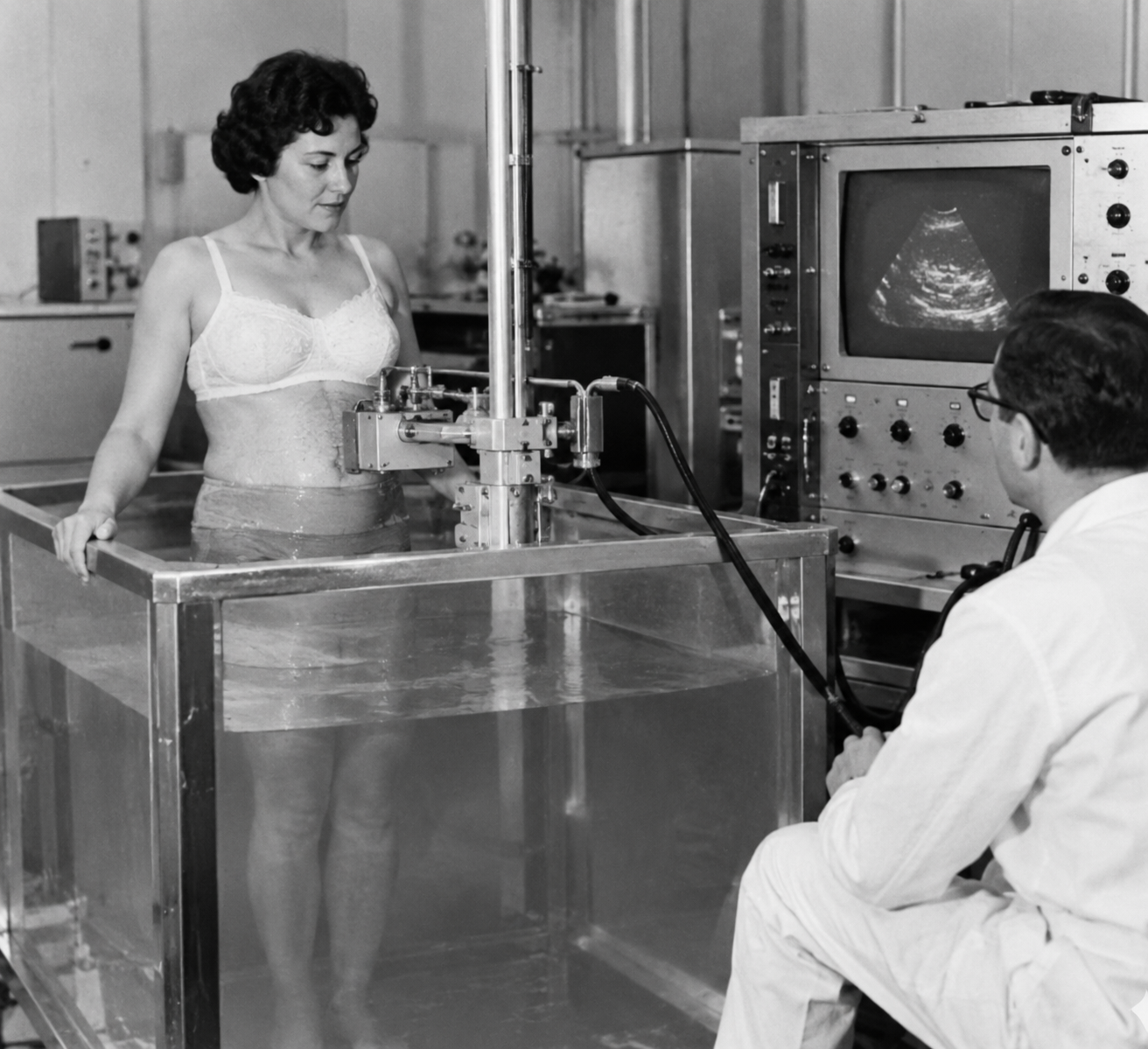
Some of the earliest ultrasound systems looked nothing like the machines we use today. Because ultrasound waves need good contact to travel into the body, early researchers experimented with water as the coupling medium (Now we use gel….you’re welcome…this question gets asked a lot!)
In some early scanning setups, patients actually had to be partially immersed in a tank or tub of water while the ultrasound equipment scanned through the water. Imagine going in for an ultrasound and being told, “Okay, hop in the tub!”
Thankfully, technology has improved dramatically (and quickly!) Eventually, water baths were replaced by direct-contact transducers and the ultrasound gel we're all familiar with today. That gel isn't just there to make a mess—it eliminates air between the transducer and the skin so sound waves can travel effectively.
And Ultrasound Wasn't Originally for Babies!
Another fun fact: pregnancy wasn't the original focus of medical ultrasound.
Early researchers investigated ultrasound as a way to detect abnormalities and structures inside the body without surgery. In the 1940s, Austrian neurologist Karl Dussik experimented with transmitting ultrasound through the skull in an attempt to identify brain abnormalities. Unfortunately ultrasound still isn’t great at penetrating bone, but there are interesting ways for us to use ultrasound through the temples and fontanels on infants!
Other researchers soon began exploring ultrasound for things like tumors, gallstones and other internal structures.
So When Did Babies Enter the Picture?
That major chapter came in the 1950s, when a Scottish obstetrician along with an engineers helped develop ultrasound for obstetric and gynecologic use.
And here's another wild connection: some of their early work involved adapting technology related to industrial ultrasonic equipment used to detect flaws in metal! Have we completely blown your mind now? - time for a nap :)
Eventually, ultrasound allowed physicians to evaluate pregnancy in a completely new way—and prenatal imaging was forever changed.
So the next time you're lying comfortably on an exam table with a little warm (or cold in some cases….I’m getting gel warmer kay guys….it’s coming, I promise!) gel on your belly, just remember...
We've come a LONG way from water tanks and industrial equipment!
And that's your Freaky Friday ultrasound fact of the week!
Until next Freaky Friday... stay curious!
Seaside Imaging of Florida | Yulee & Fernandina Beach, FL
Pregnancy Ultrasound • 2D/3D/4D & HD Imaging • Diagnostic OB Imaging • Baby Keepsakes • Newborn Photography
ultrasound history, history of pregnancy ultrasound, who invented ultrasound, prenatal ultrasound, pregnancy ultrasound Yulee FL, 3D ultrasound Yulee FL, 4D ultrasound Fernandina Beach FL, elective ultrasound Nassau County FL, diagnostic OB ultrasound Florida, Seaside Imaging of Florida, Elective 3D, 4D & HD Ultrasound Studio Serving Yulee, Fernandina Beach, Amelia Island, Nassau County, and surrounding Northeast Florida communities. 3D ultrasound Yulee FL, 4D ultrasound Fernandina Beach, HD ultrasound near me, elective ultrasound Nassau County, baby ultrasound package Florida, pregnancy ultrasound experience, heartbeat snuggle buddy, 3D baby ultrasound, 3D 4D baby ultrasound Yulee Fl, 3D 4D baby ultrasound Fernandina beach Fl, 3D 4D baby ultrasound Callahan Fl, 3D 4D baby ultrasound Hilliard Fl, 3D 4D baby ultrasound Bryceville Fl, 3D 4D baby ultrasound St. Mary’s Ga, 3D 4D baby ultrasound Maccleny FL, 3D 4D baby ultrasound Kingsland Ga, 3D 4D baby ultrasound Brunswick Ga, 3D 4D baby ultrasound Amelia Island Fl, 3D 4D baby ultrasound Jacksonville Fl, 3D 4D baby ultrasound North Jacksonville Fl.
