Why Does My Baby's Arm or Leg Look "Chopped Off" in a 3D Ultrasound?
Have you ever gone for an ultrasound appointment and spend hours over analyzing and wondering if they missed a half head or half arm at the anatomy scan because the pictures you brought home are just…..kinda scary? Why does it look like my baby only has half his face? Where’s her hand? These are questions we get ALL the time as sonographers because honestly…ultrasound is weird. The good news is that in most cases, nothing is actually missing at all. What you're seeing is simply a result of how 3D and 4D ultrasound technology creates images. Below I’ll explain why and how this happens so that you can worry less and enjoy your ultrasound pictures more.
How 2D Ultrasound Works
A traditional 2D (black and white imaging that we use for diagnostic studies) ultrasound uses sound waves to create a thin, flat slice of the baby's body. Think of it like looking at a single page from a book. If you are just looking at one page, it’s just a page…a slice of a book. However, all of the pages (slices) in the book together create a book. If you’ve ever had a CT scan, technologists create many many “slices” of the human body, which the radiologists can play back to look at all of the organs in the body in multidimensional planes . A 2D image is one of those “slices”.
With 2D imaging, sonographers can move through the baby's anatomy slice by slice, allowing them to see arms, legs, hands, feet, and internal structures from many different angles. This is why that frontal face shot is so scary to patients, because it’s a slice through the face to allow us to visualize the bone structures of the face.
How 3D and 4D Ultrasound Works
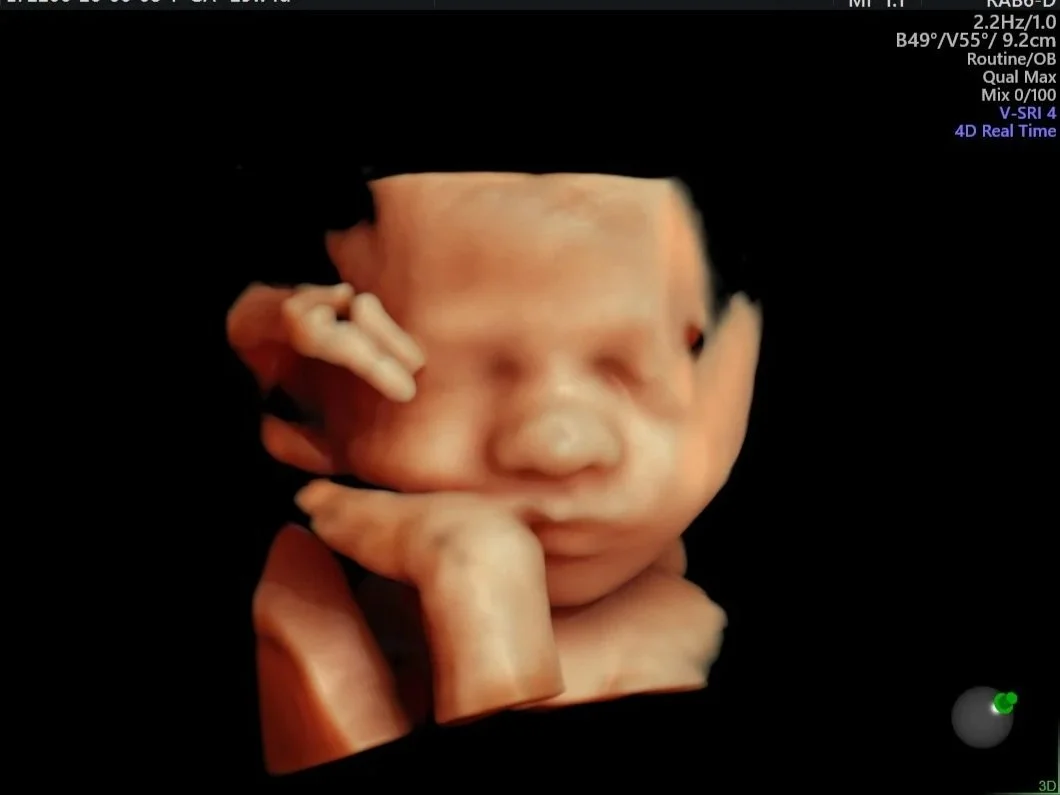
So how does 3D look like a real baby face? 3D ultrasound takes hundreds of tiny 2D images (or slices) and combines them into a three-dimensional surface rendering. Have you ever watched the sonographer obtain a still 3D? The machine sweeps through the entire profile and then manipulates those images together to create the masterpiece picture of your baby.
4D ultrasound is simply live-moving 3D imaging in real time and is obtained in much of the same way as a 3D, but in real time.
Why Limbs Sometimes Look Like They're Missing
Several factors can make arms, legs, hands, or feet appear absent during a 3D/4D ultrasound:
1. The Limb Is Behind Another Body Part
Babies love to curl up! An arm may be tucked behind the back, hidden under the chin, or positioned against the uterus. Since 3D ultrasound only displays the visible surface, the hidden limb may not appear in the rendered image. Much like a photo of a person with their arms behind their back could appear as though they are missing all together. Many times as a photographer, I’ve had to be mindful of hand placement for this very reason!
2. The Ultrasound Beam Can't Reach It
Sound waves must travel through fluid to create clear images. This is such an important concept in 3D imaging! If we can not obtain a clear profile picture of the baby with fluid in front of the face, the sound waves can’t distinguish between the tissue types and therefore won’t render a beautiful 3D result. This happens frequently with anterior placentas because babies love to snuggle their faces against the placenta, creating a less than ideal 3D image. This is one of the reasons why we recommend drinking lots and lots of fluid a couple of days before your scheduled ultrasound.
3. Rendering Artifacts
The computer has to decide which echoes belong to the baby's surface and which should be ignored. This is sometimes why you end up with pieces of the umbilical cord or parts of the placenta in your images. Most machines allow us to post process and “tell” the machine which areas to refine or cut away, but it can be difficult at times to fix if it’s touching baby’s face.
Sometimes the software removes portions of an arm or leg during processing, creating the illusion that a body part has been "cut off." Good news though….as an MFM sonographer during the week, I can confidently say that your doctor would have definitely told you if there were cause for concern over a missing limb.
5. Shadows
Just like a flashlight can create shadows, ultrasound sound waves can also be blocked by bones or other structures. These shadows may hide parts of the baby's body from view and create artifact.
Why 2D Usually Shows the Whole Limb Better
Although 3D images are beautiful and are amazing for bonding with your baby, 2D ultrasound is actually better for evaluating anatomy. Sonographers can sweep through the entire arm or leg in real time, confirming that the structures are present even when a 3D image doesn't display them clearly. This is one reason why medical diagnostic ultrasounds rely heavily on 2D imaging.
The Bottom Line
A 3D or 4D ultrasound image is a surface rendering—not a complete picture of everything inside the baby's body. When a hand, foot, arm, or leg appears missing, it is almost always due to positioning, shadows, limited fluid, or how the computer rendered the image.
At Seaside Imaging of Florida, we love helping families understand what they're seeing during their ultrasound experience. If baby is feeling camera-shy, don't worry—we'll do our best to find the perfect angle and capture those precious moments! I look forward to seeing you soon!
It is important to note that 3D keepsake imaging does not replace diagnostic scans performed by your OB provider. Our studio is owned by a licensed sonographer, but this studio does not perform diagnostic exams. All scans performed at Seaside Imaging of Florida are for entertainment purposes only and should not replace regular prenatal care.
3D ultrasound, 4D ultrasound, elective ultrasound, baby ultrasound, why does my baby look missing limbs on ultrasound, 3D ultrasound artifacts, pregnancy ultrasound, Fernandina Beach ultrasound, Yulee fl ultrasound, Jacksonville fl3D ultrasound, Callahan fl ultrasound, Hilliard fl ultrasound, St. Mary’s Ga 3D 4D ultrasound, Brunswick Ga 3D ultrasound, Kingsland Ga 3D 4D ultrasound, Amelia Island Fl 3D 4D ultrasound.
